
HomeService areasEnterprise
SERVICE AREA
AC Repair in Enterprise, Las Vegas
Colton Air Conditioning repairs AC, gas furnaces and heat pumps in Enterprise, ZIPs 89141, 89139 and 89178, including Mountain's Edge and Southern Highlands. We provide residential AC repair and HVAC service in Enterprise and the southwest Las Vegas Valley, including Mountain's Edge, Southern Highlands, and nearby Fort Apache-area neighborhoods. Enterprise and the neighborhoods around it are full of 2000s production homes whose original condensers are at the end of a hard run. We diagnose the equipment at the house before recommending a repair or replacement.
Nevada contractor license 0092120.
Call (702) 738-6976 first.
6545 S. Fort Apache Rd Ste 135 #467, Las Vegas, NV 89148 is a mailing address only. It is not a walk-in shop. The repair happens at the house.
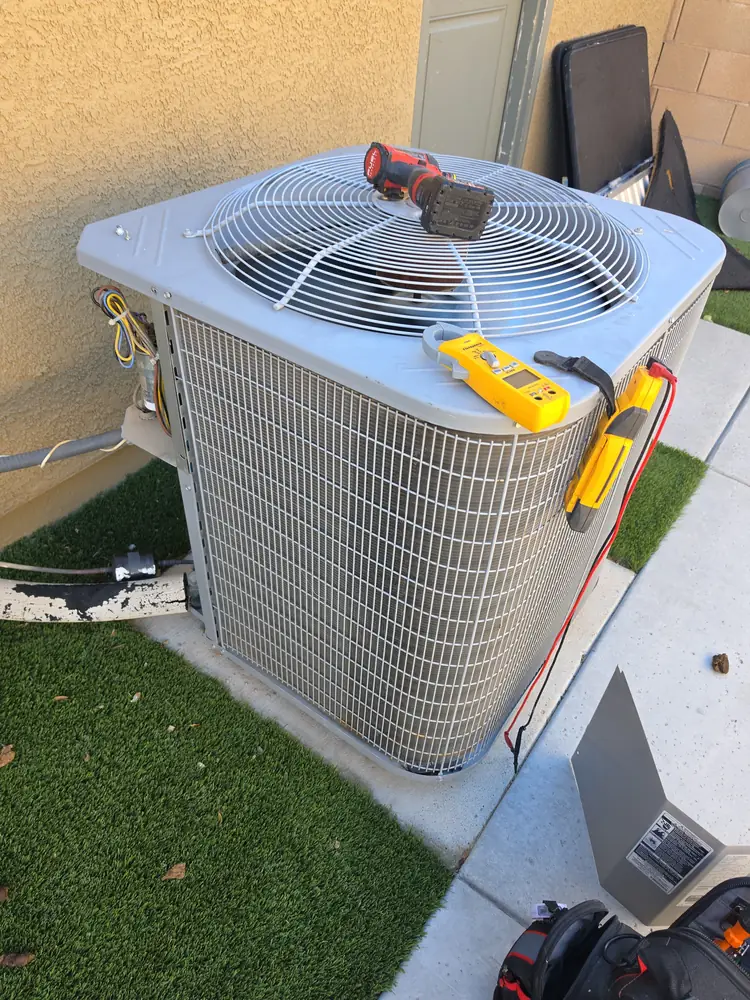
Hot afternoons expose weak capacitors, contactors, motors, airflow, drains, coils, and ductwork. A system that runs but does not cool is not automatically a failed compressor, and a failed capacitor is not a reason to sell a new condenser.
What homeowners run into
Common Enterprise calls include:
- Warm air at the registers while the outdoor unit runs
- A condenser that hums or will not start
- A breaker that trips when cooling starts
- Ice on the refrigerant lines
- Water near an air handler, closet, or ceiling
- A system that runs for hours without reaching the thermostat setting
- One floor staying warm while another area remains comfortable
- A replacement recommendation made before the failed part was explained
Two-story homes can have separate systems. If one system is not keeping up, we test that system rather than assuming both need replacement.
Repair or replace
A confirmed minor failure is a repair. Replacement may be worth discussing when the system has limited useful life, a major repair is disproportionate to the remaining equipment, refrigerant considerations make another major repair a poor choice, or the same system has repeated failures. See AC replacement in Las Vegas. For heating, see furnace repair. If another company recommended replacement, see HVAC second opinion.
How fast Enterprise was built, and why it matters for your system
Enterprise is an unincorporated town in Clark County, so permits and building inspections go through Clark County, not the City of Las Vegas. Its growth happened quickly. The Census counted 14,676 people in 2000 and 221,831 in 2020. The most recent Census survey (ACS 2020–2024 five-year estimates) puts it at about 240,000.
For HVAC, the housing matters more than the population. In that same survey, about half of Enterprise housing units (50.1%) were built from 2000 to 2009, about 28% from 2010 to 2019, and about 6% since 2020. Fewer than one in six units are older than 2000. Las Vegas as a whole is the reverse: nearly 39% of its units are from before 1990.
So in Enterprise, the question is rarely "what is this 1970s system?" It's which of three equipment generations you have:
- Mid-2000s originals. Some early ones were built for R-22. EPA ended R-22 production and import on January 1, 2020, so servicing those systems depends on recovered or stockpiled refrigerant.
- 2010s systems. These are mostly R-410A, often in mid-life, where capacitors, contactors and fan motors are the usual repairs.
- 2020s systems. Under EPA's Technology Transitions rule, new residential split systems are moving to lower-GWP refrigerants such as R-454B and R-32. Those need technicians and parts suited to that refrigerant class (ASHRAE safety group A2L).
The first step on any Enterprise call is to read the data plate: the manufacture date, the refrigerant and the tonnage. That tells us which of these three cases we're dealing with before we talk about a repair.
Not every Enterprise home is a detached house
About 73% of Enterprise housing units are single-family detached, which is lower than in its master-planned neighborhoods. The rest are townhomes, condos and apartments. That changes the service call:
- Condensers for attached homes may sit in a shared side yard, on a ground pad in a row, or on a roof. Access sometimes runs through an HOA or property manager, so it helps to know the unit's location and any gate access before the visit.
- Stacked and attached units often have the air handler or furnace in a hall closet instead of an attic. Water from a blocked condensate drain shows up on flooring or a neighbor's ceiling, not in the attic insulation. See AC leaking water.
- Rows of identical condensers make it easy to service the wrong one. We match the unit to the address before opening a panel.
What Enterprise's climate actually asks of a system
Enterprise has no official NOAA normals station of its own. The closest long-term record is Harry Reid International Airport (station USW00023169). Its 1991–2020 normals show:
- About 3,720 cooling degree days a year, against about 1,836 heating degree days. Cooling load is roughly twice the heating load.
- On average, 78 days a year reach 100°F and 137 days reach 90°F.
- A July average low of 82.0°F, so condensers get little cooling-off time overnight in midsummer.
Enterprise covers a large area. A USGS elevation point near the center of the town reads about 2,530 feet, compared with about 2,110 feet at the airport. Higher ground on the west side is often a little cooler on clear winter nights. That's a general tendency, not a measured Enterprise normal, so we size and diagnose equipment using real measurements at the house rather than a neighborhood rule of thumb.
Furnace and heat pump repair in Enterprise
Census data shows about 70% of occupied Enterprise homes heat with utility gas and about 26% with electricity. Electric heat usually means a heat pump, sometimes with backup heat strips. Heat pump owners will see normal defrost cycles on cold mornings (heat pump defrost mode). In gas homes, a dusty smell the first time the heat runs each fall is normal and can linger a couple of days. If you smell gas, leave the house right away. Don't use light switches, thermostats, appliance controls or anything that could spark. Once you're outside, call 911 and Southwest Gas (877-860-6020). If a CO alarm sounds, get everyone outside and call 911.
For a no-heat call, see furnace repair in Las Vegas.
Cold desert nights and Enterprise heating
Las Vegas-area winter days are mild, but nights are not. At the nearest long-term weather station, Harry Reid International Airport, the 1991–2020 normal low is 39.6°F in December and 40.5°F in January, with daytime highs in the mid- to upper 50s. On average the airport records a few nights below freezing each December and January. Clear desert skies let heat escape after sunset, so most of a home's heating work happens overnight and early in the morning, not during the afternoon.
That pattern is why a heating problem often shows up first on a cold morning: the system has been running steadily for hours, and a weak part finally gives out.
Gas furnaces. Most Enterprise homes heat with gas, usually a furnace in the attic, garage or a hall closet that shares its blower and ductwork with the AC. Because the same blower moves air in both seasons, a summer of hard cooling can leave a furnace with a loaded filter, a dirty blower wheel or a weak blower motor capacitor before the first cold night. Common no-heat causes on 2000s and 2010s furnaces include a dirty flame sensor, a failed igniter, a tripped limit switch from restricted airflow, a blocked condensate drain on high-efficiency models, and thermostat or wiring faults. See heating repair and furnace repair in Las Vegas.
Heat pumps. Many newer all-electric Enterprise homes use a heat pump, which heats and cools with the same outdoor unit and reverses itself in winter. Desert nights near 40°F are well within a heat pump's normal range, but long overnight runs will expose a sticking reversing valve, a failing defrost control, low refrigerant charge or backup heat strips that are not coming on. If the outdoor unit runs but the house stays cool, or your electric bill jumps on cold nights, that points to backup heat doing the work the heat pump should. See heat pump service.
A heating check before the cold nights
A heating check looks at the parts that fail on the first cold nights: the burner, flame sensor, igniter, safety switches, venting, filter and blower on a gas furnace, and defrost operation, reversing valve and backup heat on a heat pump. On a gas furnace we also look at the heat exchanger and check the venting. See heating maintenance. Comfort Club plans include maintenance visits. See Comfort Club plans.
Book online or call (702) 738-6976 to schedule.
Common repairs on 2000s and 2010s Enterprise systems
- A failed capacitor or contactor: an outdoor unit that hums or won't start
- A dirty condenser coil that makes a healthy compressor look like it's failing
- A frozen coil from an airflow restriction or low charge
- A furnace flame sensor or limit switch on the first cold mornings
For an original mid-2000s system with a major failure, see repair or replace an old AC and HVAC in 2000s homes.
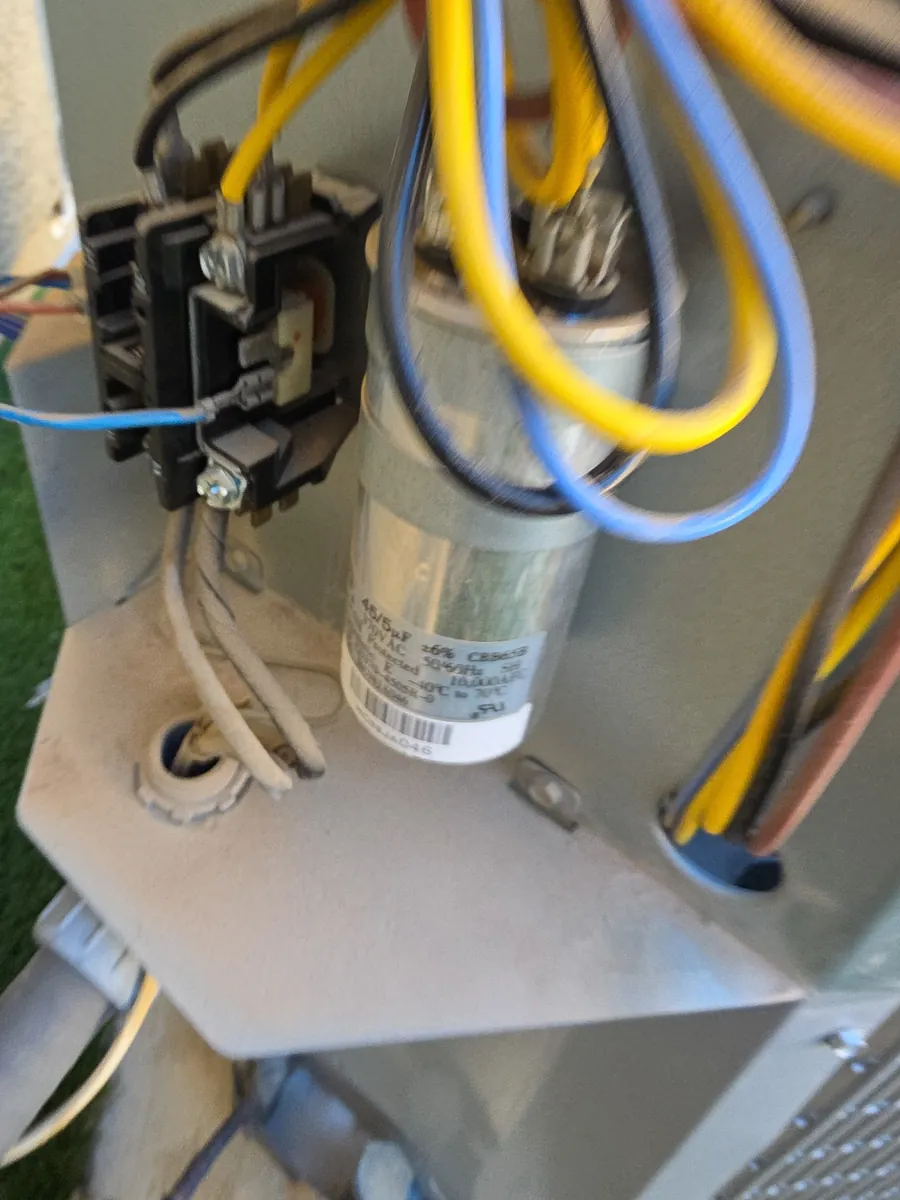
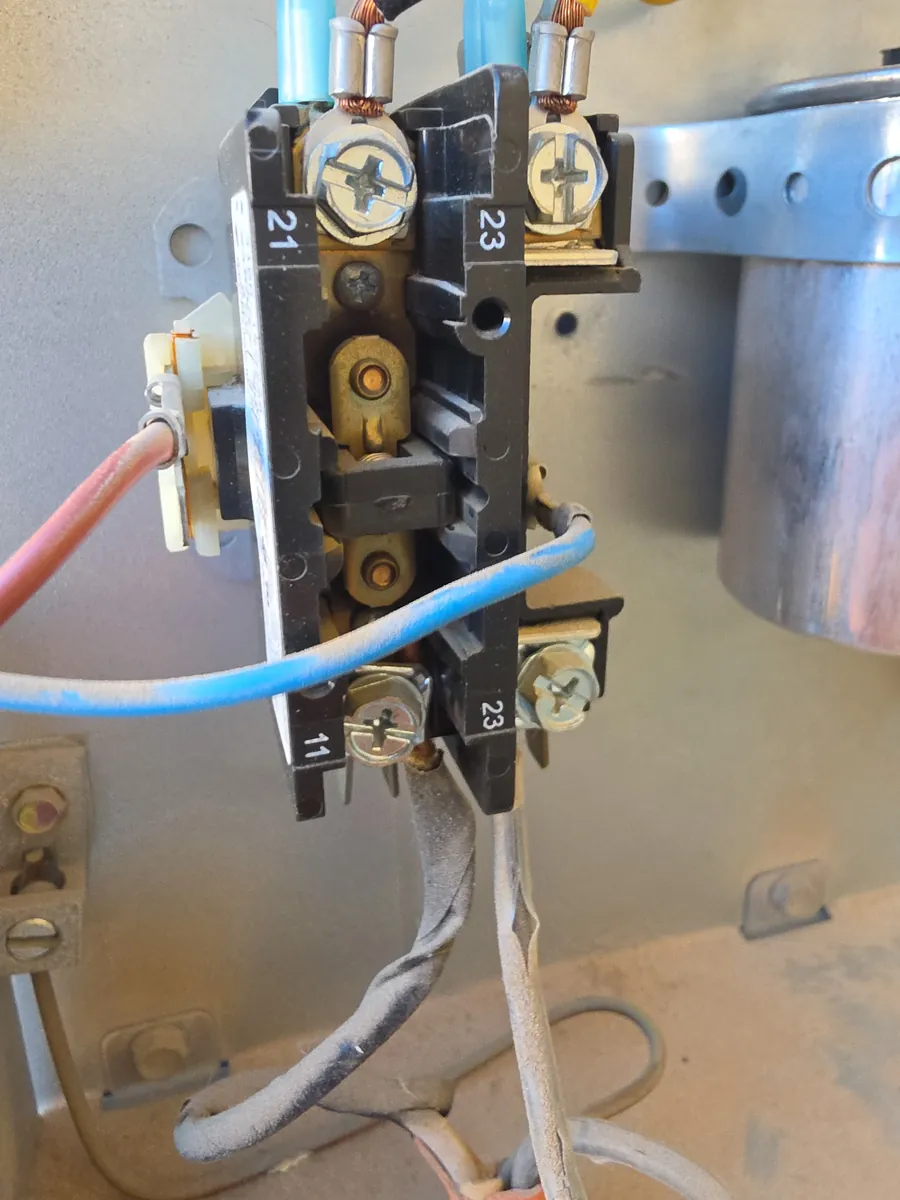
Recent work near Enterprise
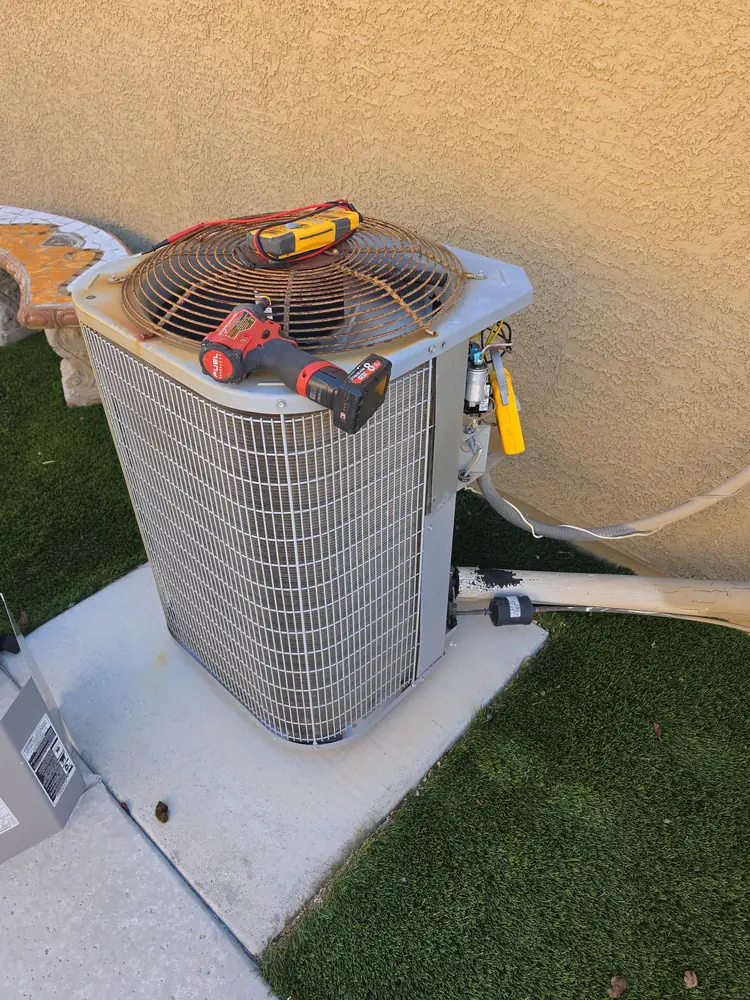
- Condenser fan motor replacement, ZIP 89178, July 2026.
- Two gas/electric split systems installed with a condensate drain trap, gas line sediment trap, electrical disconnect and flue pipe replacement, ZIP 89178, June 2026.
- Gas/electric split system installed with a new electrical disconnect, condensate drain trap and gas line sediment trap, ZIP 89178, April 2026.
Nearby
Mountains Edge is a master-planned community inside Enterprise. Silverado Ranch lies to the east, and Southern Highlands and Spring Valley border the area. For valley-wide service, see AC repair Las Vegas. Book online or call (702) 738-6976 to schedule.
Services in Enterprise
FAQ
Is Enterprise part of the City of Las Vegas?
No. Enterprise is an unincorporated town in Clark County. Addresses use Las Vegas as the mailing city, mostly in ZIP codes 89141, 89139 and 89178, but permits go through Clark County.
How old are most HVAC systems in Enterprise?
About half of Enterprise housing was built from 2000 to 2009 and about 28% from 2010 to 2019, so most systems are original 2000s equipment or 2010s units in mid-life.
What refrigerant does my Enterprise AC use?
It depends on its age. Some mid-2000s systems use R-22, most 2010s systems use R-410A, and newer systems are moving to lower-GWP refrigerants such as R-454B or R-32. The data plate on the outdoor unit shows it.
How cold does it get at night in Enterprise?
The nearest long-term weather station, at Harry Reid International Airport, has 1991–2020 normal lows of about 40°F in December and January, with a few nights below freezing in an average winter. Higher ground on the west side of Enterprise can run a little cooler on clear nights.
Should I have a gas furnace or a heat pump in my Enterprise home?
Most Enterprise homes already have one or the other, and the right choice for a replacement depends on whether the house has a gas line, the condition of the ductwork and what the existing equipment was built for. Desert winter nights are well within a heat pump's normal range, and a gas furnace remains common in homes with gas service. We look at the house before recommending either.
Why does my heat pump blow cooler air than a furnace?
A heat pump delivers a steady stream of warm air that feels cooler at the register than the hotter air from a gas furnace, so it runs longer to heat the house. That is normal. Air that stays cold, or a system that leans on its backup heat strips, points to a problem worth checking.
Service area
This page covers Enterprise, Mountain's Edge, Southern Highlands, and nearby southwest Valley neighborhoods. Nearby area pages: Spring Valley, Summerlin, Henderson. Valley-wide: AC repair Las Vegas.
Nearby: Spring Valley AC and heating repair.
What to do next
Call (702) 738-6976 and describe the symptom, or Book Online. License 0092120.
Colton Air Conditioning · Colton Mechanical LLC · License 0092120 · (702) 738-6976 · Mailing address: 6545 S. Fort Apache Rd Ste 135 #467, Las Vegas, NV 89148
Heating and cooling in Enterprise
AC repair in Enterprise
Diagnosis first. A minor part stays a repair.
AC replacement in Enterprise
Matched indoor and outdoor equipment, sized to ACCA standards.
Furnace repair in Enterprise
No heat, a flame that drops out, or a heat pump stuck on emergency heat.
AC maintenance in Enterprise
Cooling in spring and a heating safety check in fall.
HVAC second opinion in Las Vegas
Told you need a new system. We open the panel before we agree.